What is in the air, in the ground, and red all over?
Dust. Big Island, Hawaiian dust.
We trundled up a little-known dirt road that most navigation systems don’t recognize. The best directions I found were from a local friend’s text message, not the public group I inquired with when other research failed me. It’s a place not many people go, and we are not going to see people.
Windows down, sun roof open, radio off. We are here to bird. Or, at least I am. I balance on the center console in what is best described as an awkward ballerina squat, one hand on the roof, the other holding my binoculars. I am surfing this secluded, high-elevation dry forest…don’t let anyone convince you that birding is strictly a leisurely activity. My boyfriend drives, dutifully stopping when I give the signal, so I can identify the bird or suspicious leaf that catches my eye. Sometimes he even seems interested in what I’ve spotted. Mostly I find birds I’ve seen before, non-native Japanese white-eyes and the more exciting, endemic Amakihi. Although spotting Amakihi is like seeing an old friend as they dash by on an errand (No time to stop and chat! Call Me!), today I am hoping for a glimpse of something…someone…new.
Eventually, we reach a sign that confirms we followed the secretive directions correctly. We park outside the fence of the Palila Forest Discovery Trail, now one of two vehicles, a stark difference from the popular destinations of Kona, Hilo, or Volcanoes National Park. The fence is there to protect native flora and fauna from many scourges to the Hawaiian ecosystem. In this case, it’s primarily invasive mammals- humans included. The entry point is supplied with tools and instructions for cleaning footwear before and after accessing the enclosure, because people are apt to track invasive plants in, even when they have the best intentions.
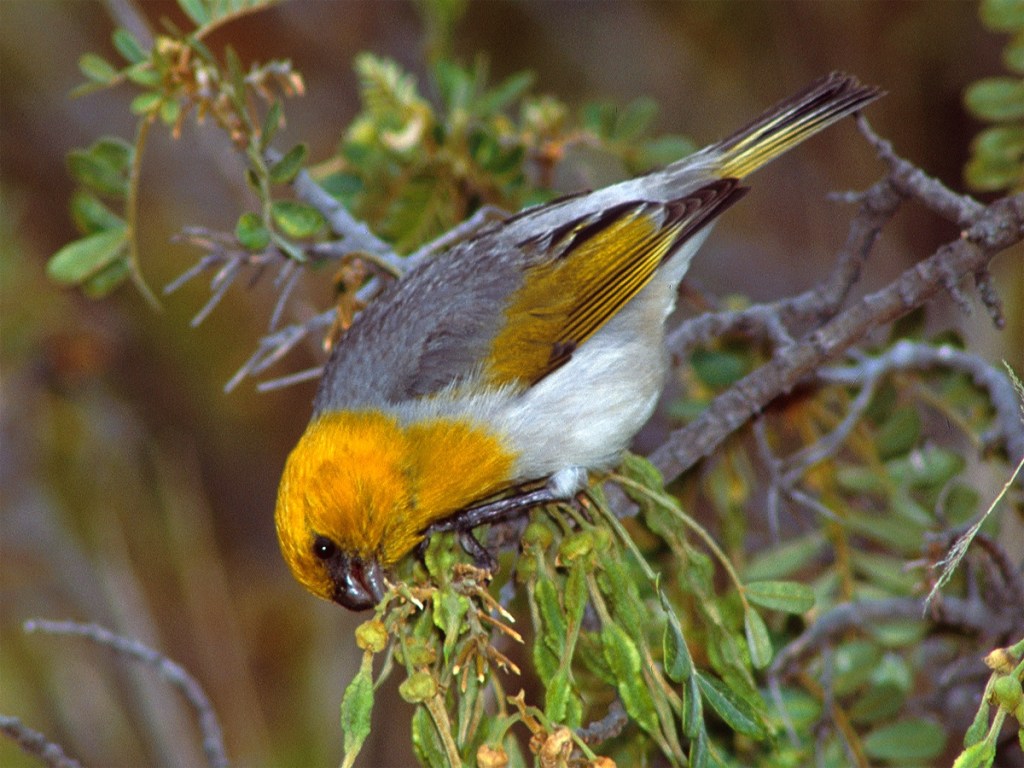
The trail’s namesake is my quest…the Palila, or Loxioides bailleui. Most people have never heard of Palila, let alone seen one. For a good albeit unhappy reason, as there aren’t many of these little birds left. Once widely distributed, Palila are now restricted to Big Island high-elevation forests plentiful in their favorite food: the māmane tree (Sophora chrysophylla). On top of that (literally, as this is on the slopes of the Mauna Kea, the tallest mountain in Hawai’i), you can count on your fingers the percent of original range this space occupies (~5-10%). Approximately 900 Palila remain in the wild. To put this in a relatable perspective, if Palila were pennies (because alliteration- I’m a writer not a mathematician) we would have $9.00. And we are short…$81.00 short.
Still, nine dollars is nine dollars, and we set off on foot into the fenced-in thin air for a payday. The best chance to see Palila is before their nesting season, which generally begins in the late spring. Nesting time is stealthy- they sneak to and from their nests so as to not give away the location to predators…or fans. Mating season precedes nesting season, and this is the raucous reality dating show when they loudly sing to attract mates and defend territory as they pair off. I’m early, but am optimistic that eager birds will be singing, “I’m here! This tree is mine! I’m single and ready for the māmane mingle!”
The cool wind is a blessing and a curse up here- disguising the strength of the sun and making the leaves rustle like there’s a bird behind them. I scan for movement and flashes yellow- the brightest color on Palila, covering their head like a hood. Most of the yellow I spy belongs to another Amakihi, or the clustered māmane flowers.
Hoping to hear a Palila song, I am also listening for the munching sound of Palila eating māmane seeds. Methodically and patiently, we walk every trail…twice. After no luck, we position ourselves at strategic vantage points that I have deemed “very birdy.” Occasionally, we encounter the occupants of the other vehicle, and quietly ask each other, “Any Palila yet?” At each meeting the question is the same but abbreviated, “Palila?” Eventually evolving to just raising eyebrows and shaking heads.
After an hour or so, the other birders depart. I stay. Luckily, so does my boyfriend. Finally, in the distance on the edge of my hearing range, a new whistling sound emerges. It could be a Palila. A melodic and hurried, “how are you?” I am encouraged, but the hours are lengthening, and I don’t hear the curious sound repeated.
I knew it was possible that I wouldn’t find Palila today. It’s always a potential outcome When looking for these critically endangered birds, I let my optimism and experience convince me that I could find one. In hindsight, I wasn’t wrong. I COULD, but it wouldn’t be here today.
As we departed, I abandoned my sunroof surfer stance. Amakihi continued to amuse themselves almost everywhere I looked. Reflecting on my time on the Palila Discovery Trail, it was time well spent. It’s hard to immerse yourself in the tranquility and beauty of a Hawaiian forest and not feel good about it.
Ultimately, I am grateful for today. There may be a day in the future when Amakihi sightings are considered rare, given the general yet alarming population trends of native Hawaiian birds, and people will joyously shout, “ANOTHER Amakihi!” I attentively look out the window the entire drive- just in case.
We rolled into Hilo, our bodies and truck covered in dust. I morbidly ponder the concept of Palila extinction. If they die, their bodies will eventually become dust, and they will again whizz through the air all over the island. A solid stab at poetic symbolism on my part, but it disheartens me to think of the equally dusty, and desiccated museum samples becoming the best way to know Palila. The sample I saw at the Bishop Museum in Honolulu lacked the substantial fluff, chonk, and personality I believe these birds possess. My boyfriend releases the window washing fluid, bringing my thoughts back to the present. Through the windshield wipers, I see a red, dusty Palila. It’s massive…stretching from the ground two stories up in the air. The mural is unexpected, hidden off the main street.
It’s not the Palila I hunted for, but it’s still meaningful to me. Someone wanted to ensure people saw Palila, chonk included, and found a way. The birds are not yet dust in the wind, and perhaps someday, we may see them all over the island again. Until then, I am pleased to know they are still here with us.
Additional reading and ways to help Palila:
• https://abcbirds.org/bird/palila/
• https://dlnr.hawaii.gov/wildlife/birds/palila/
• https://bigislandnow.com/…/palila-showcased-in-mural…/

 EmilyLouina.com